Anglo Saxon Translator: Old English, clarified
Bridge eleven centuries in a paste and a click: see how your sentences might look in early medieval English—before Norman scribes reshaped the court—when cyning meant "king" and þing could mean "assembly" as well as "thing."
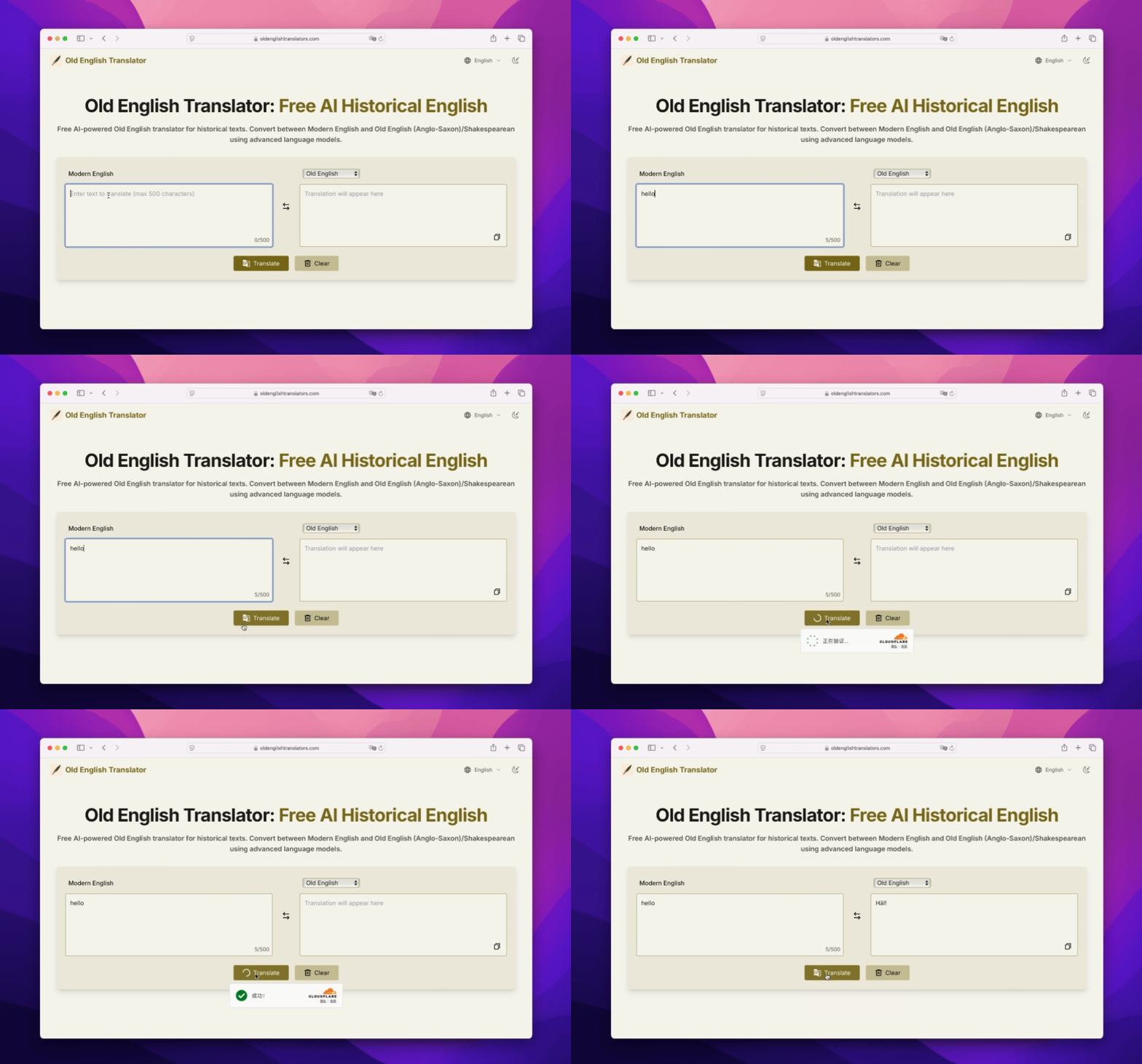
How to use this translator
Three quick steps from plain English to wording you can compare with glossed Anglo-Saxon manuscripts—or simply discuss with your instructor.
- Enter your English textPaste full sentences rather than isolated keywords; simple syntax usually yields clearer archaic parallels.
- Pick a directionChoose modern-to-historic for composition exercises, or flip for a gloss when you are staring at manuscript-style wording.
- Translate and refineRun the conversion, note unfamiliar spellings (thorn þ, eth ð, ash æ), then iterate—accuracy grows when you trim idioms modern readers take for granted.
Built for learners and readers
Concrete help for homework, re-enactment scripts, or curiosity about how English sounded in Anglo-Saxon England—before French and Latin reshaped the elite lexicon.
AI-powered historical translation
Large-language-model output tuned for archaic vocabulary and word order so you spend less time guessing glosses and more time comparing variants.
Grounded in real manuscripts
Outputs echo patterns found in edited prose and verse—not fantasy dialect—so you can cross-check against editions of Ælfric, Bede, or poetic codices.
Free, unlimited use
No quotas or subscriptions for casual learners; run as many drafts as you need while you refine wording or prep a classroom example.
Teaching-friendly explanations
Ideal companion when introducing weak adjectives, subjunctive coloring, or why Old English feels like a cousin of German and Icelandic—skills that carry straight into reading Anglo-Saxon Chronicle entries aloud.
Bidirectional switching
Modern → historic for composition practice, historic → modern when you want a readable crib beside the gloss—without juggling five websites.
Context over catchphrases
Understand why Norse borrowings sit alongside West Germanic roots and how that mix still shows up in pairs like skirt/shirt today.
Questions worth asking
Straight answers about Old English, this tool, and why the written record looks nothing like a textbook.
What was Old English, really?
West Germanic dialects spoken in Britain from roughly the fifth century until the Norman Conquest reshaped elite culture—it is not Shakespeare, not Chaucer. Strong verbs like singan/sang/sungen mirror patterns still visible in German. Literary Old English preserves four cases on nouns and adjectives (nominative, accusative, genitive, dative) and three grammatical genders, which is why þæt scip "that ship" is neuter while se cyning "the king" is masculine. Regional labels such as Mercian or Northumbrian describe Anglo-Saxon kingdoms whose spelling habits still surprise beginners.
How accurate is AI for this?
Models interpolate from thousands of edited texts, so fluency can outpace certainty: always verify crucial homework or publication wording against Bosworth-Toller or Clark Hall. Treat output as an educated reconstruction, not a vow-in-court edition.
Why bother learning Old English today?
Because roughly half of our everyday vocabulary still carries Germanic bones—house, drink, mother—and reading even short passages rewires how you notice metaphor in Beowulf or legal archaisms in modern statutes. Pair machine drafts with a grammar primer and the leap stops feeling impossible.
Runes, Latin letters, and the Anglo-Saxon alphabet
Most surviving literary texts use an insular Latin alphabet augmented by þ, ð, æ, and sometimes ƿ (wyn). Monumental or occasional epigraphic writing could employ the Anglo-Saxon futhorc, an extended runic row adapted from continental models—so "the alphabet" was bilingual in practice: Roman script for parchment, runes for metal, wood, or display.
Did Vikings rewrite the language?
Norse speakers ruled and traded across wide stretches of the Danelaw after the ninth century, leaving hundreds of everyday loans: give, take, sky, egg, skirt, and the pronoun they/them/their replaced earlier native forms in the plural. Anglo-Saxon speakers along the eastern seaboard borrowed hardest; that contact layer is why Old English lexicon feels partly Scandinavian when you line it up against Old High German.
What famous line opens Beowulf?
Manuscript Cotton Vitellius A xv begins Hwæt! We Gardena in geardagum þeodcyninga þrym gefrunon—often translated as "Listen! We have heard of the glory of the kings of the Spear-Danes in days gone by." Hwæt functioned as an attention-grabber, not our casual "what," which is the sort of pragmatic shift machine translation can gloss over unless you already know the pragmatics.
May I cite this output in a paper?
Use it for brainstorming and first-pass glosses only; journals expect diplomatic transcripts or peer-reviewed editions. Quote the scholarly source you verified, not the chat-style paraphrase.
Is there a cost?
No—the workflow stays free so teachers can demo þorn letters on a projector and hobbyists can experiment without a credit card. Heavy institutional use may eventually warrant separate hosting limits, but casual learners are the intended audience.