Middle English Translator: Free Medieval English Converter
Move between Modern English and the medieval stage of the language—the register of Geoffrey Chaucer’s Canterbury Tales, which famously opens: “Whan that Aprille with his shoures soote.” This converter helps you explore spelling, vocabulary, and sound change without replacing careful reading of originals.
How to Use Middle English Translator
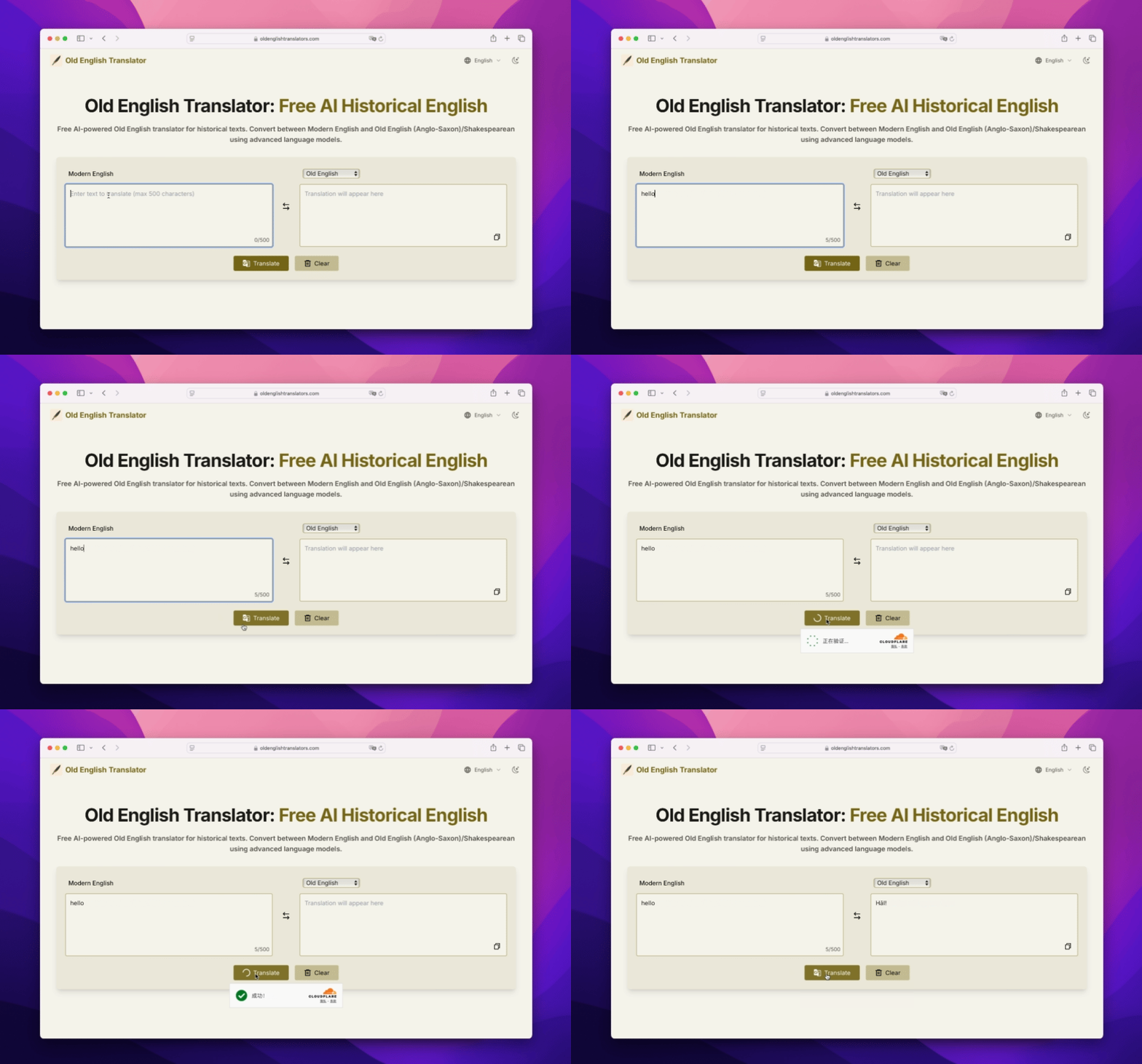
Three quick steps: paste text, pick direction, generate—then compare with your textbook or TEAMS edition for grammar and dialect.
- Enter Your TextPaste your passage. Short, clear sentences convert most reliably; poetry may need manual tweaks for meter and rhyme.
- Choose Translation DirectionUse the swap control for Modern → medieval or medieval → Modern, depending on whether you are composing or decoding.
- Generate and cross-checkRun translate, then compare specialized vocabulary (French-derived courtly terms vs. Germanic roots) and regional markers against a scholarly glossary when precision matters.
Middle English Translator Features
Purpose-built help for classroom reading, creative experiments, and comparing medieval wording with today’s—without pretending one dialect stood for all of England.
AI-assisted medieval wording
Turn plain Modern English into period-flavored prose or unpack archaic lines into clearer contemporary wording. Use alongside manuscripts and editions of works such as The Canterbury Tales—not as a substitute for scholarly glossaries.
Literature-informed tone
Outputs aim at conventions familiar from fourteenth- and fifteenth-century London and Midlands texts. Remember that Middle English varied sharply by region: Chaucer’s London English differs from Northern verse such as Sir Gawain and the Green Knight.
Free, unlimited use
No subscription wall—explore parallel passages, draft teaching examples, or try alternate glosses as often as you like.
Teaching-friendly framing
Pair conversions with mini-lessons on French loans after the Norman Conquest, the gradual fixing of “ye” versus “the,” and letters such as thorn (þ for “th”) and yogh (ȝ, often “y” or guttural sounds depending on word and region).
Two-way conversion
Swap direction to modernize a medieval excerpt or to craft stylized medieval English dialogue—always verify unusual spellings against a dictionary or edition.
Sound change in context
Use results as a springboard to discuss how pronunciation drifted: much of what feels “odd” in spelling reflects later shifts—notably the Great Vowel Shift—that carried the language from Middle English toward Early Modern English (think Shakespeare’s stage).
Middle English Translator FAQ
Timeline, Chaucer, spelling, loans, dialects, and how this tool fits serious study.
What is Middle English?
Roughly 1100–1500 CE English: still inflected in places, absorbing huge numbers of French loanwords after 1066, and surviving in rich dialectal variety. Geoffrey Chaucer’s Canterbury Tales—opening “Whan that Aprille with his shoures soote”—is the parade example most readers meet first.
How accurate is conversion?
Helpful for gist, classroom demos, and experimentation; not a peer-reviewed edition. For publications or exams, confirm readings against Middle English dictionaries, glossaries, and your instructor.
Why study this period?
You read primary texts (not only Chaucer—Langland, Gower, mystery plays, lyrics) in something closer to their native clothes, and you see how politics, contact with French, and regional identities shaped the words we still use.
How does the underlying AI approach work?
Large models trained on mixed modern and historical English approximate spelling and lexicon. They cannot know which manuscript witness you mean; treat output as a hypothesis to test.
Is this service free?
Yes—full access without payment so learners can iterate freely alongside print and digital editions.
How far is it from today’s English?
Closer than Old English, but spelling and some vowels diverge because written forms froze while speech moved—especially across the Great Vowel Shift toward Early Modern pronunciation patterns.
Can I cite output in a paper?
Treat automated glosses as drafts only; cite established scholarly translations or your own analysis backed by primary-text evidence.
Which texts should I read next?
Beyond The Canterbury Tales, try Sir Gawain and the Green Knight (different dialect), Piers Plowman, Malory’s Morte d’Arthur, and civic or religious drama—each illustrates distinct vocabulary and scribal habits.