Old English Dictionary: AI Word Lookup
Search headwords the way scholars do: against the tradition of Bosworth-Toller and related Anglo-Saxon lexicons. Many everyday Modern English words descend straight from West Saxon and Mercian usage—Old English words like wyrd (fate, ‘weird’), bēo (‘be’), hūs (‘house’), water/wæter—while others entered later from Latin and French. This lookup surfaces glosses, spelling variants across dialects (West Saxon vs Mercian vs Northumbrian), and related lemmas so you can see word families (shared roots and prefixes) rather than isolated glosses. Dig into vivid compounds too: wergild (‘man-price,’ blood-money compensation) or poetic coinages such as wyrmgeard (‘serpent enclosure,’ a kenning-like compound). Whether you are reading Beowulf, charters, or glossaries, you get structured vocabulary context—not generic filler.
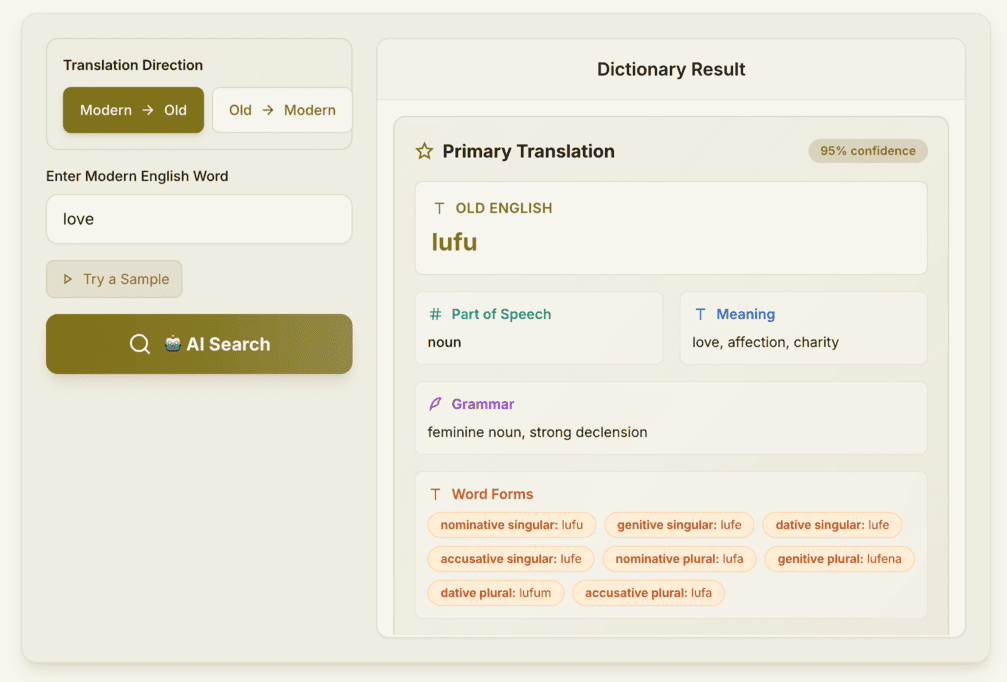
Translation Direction
Dictionary Result
Enter a word and click AI Search to see detailed Old English translation and analysis
What Is an Old English Dictionary?
A dedicated Old English dictionary lists Anglo-Saxon headwords with meanings, spelling variants, and often dialect labels—think Bosworth-Toller as the landmark printed authority modern digital projects echo. Pinpoint Old English words in situ faster than flipping appendix glossaries alone: type a lemma or a modern gloss, call up morphological hints, and jump between cognates and borrowed strata (core Germanic vocabulary versus church Latin or learned borrowings). It is built for word-level study, not full-passage translation.
- Headwords Spanning RegistersCover heroic verse, homilies, wills, and mundane chatter: lemmas tagged by sense let you see liturgical Latin loans beside inherited Germanic roots, with pointers to common spelling swings across manuscripts.
- Modern ⇄ Anglo-Saxon SearchJump from a gloss like blood-money or fate to historical lemmas (for example wergild, wyrd) or reverse direction when you only know the archaic spelling.
- Morphology & Lemma FamiliesUnpack prefixes, ablaut grades, and related forms so æt-, ge-, and verbal stems cluster intelligibly instead of hiding as one-off typos.
Capabilities Built for Serious Readers
Fast lookups, dialect-aware variants, and transparent limits—so you spend time on texts, not guesswork.
Immediate Gloss Results
Submit a headword or gloss and get prioritized senses with Modern English equivalents in moments—ideal when lecture prep or translation homework cannot wait.
Manuscript & Literary Context
Notes highlight poetic versus prose usage, common compounds (like wyrmgeard-style imagery), and reminders about shifting meanings across centuries.
Layers of Vocabulary
See when a lemma is inherited Germanic stock versus a Latin borrowing (ecclesia-style loans) so historical English stops feeling like one flat soup.
Scholarly Cross-Checks
Treat outputs as a springboard: verify rare senses against Bosworth-Toller, Toronto’s Dictionary of Old English materials, or your instructor’s glossaries before citing in papers.
No Paywall on Lookups
Unlimited searches without subscriptions—because stumbling on an unfamiliar lemma mid-chapter should never trigger a checkout screen.
Responsive Workspace
Thumb-friendly columns and wide-desktop layouts keep citations side-by-side whether you are in an archive reading room or on a couch with a paperback anthology.
Lookup FAQ
Straight answers on accuracy, dialect coverage, Latin layers, and how this compares to canonical lexicons.
How does this relate to Bosworth-Toller?
Joseph Bosworth and T. Northcote Toller’s Anglo-Saxon Dictionary remains the classic scholarly landmark; modern databases extend that lineage with searchable slips and corpus tagging. Use this lookup for speed, then anchor disputed senses in Bosworth-Toller, the Dictionary of Old English (DOE), or glossaries your course assigns.
Which dialects appear in results?
West Saxon dominates surviving manuscripts, so it appears most often, but Mercian and Northumbrian spellings surface when lemma variants are attested—think alternate vowels or consonant treatments in Anglian texts. Labels (when shown) remind you that spelling is scribal and regional, not Modern English standardization.
Germanic roots versus Latin borrowings—why care?
Old English blended inherited West Germanic vocabulary with church Latin and later Continental loans. Recognizing the split explains doublets (native fire versus borrowed ignite-type patterns centuries later) and helps you date stylistic choices in homilies versus heroic verse.
What are word families in practice?
Related lemmas share ablaut, prefixes, or derivational endings—groups around concepts like binding, knowing, or riding. Seeing those clusters beats memorizing isolated glosses because you learn predictable morphological patterns alongside vocabulary.
Can I rely on this Old English dictionary for graded work?
Use it to propose glosses and jog memory, then verify rare compounds (wergild-level legal terms, ornate kennings) against primary editions and faculty-approved lexicons. AI-assisted lookups accelerate reading but do not replace citation-ready paleography or textual scholarship.
Dictionary versus translator—which should I open?
Stay here for lemmas, dialect variants, and morphology notes. Open the sentence-level Old English Translator on the homepage when you need fluent Modern English for whole clauses—syntax and pragmatics differ from single-headword glossing.